
Parkinson’s Law: Why tasks take longer than they should
Parkinson’s law states that work expands to fill the time available. Discover how this principle explains procrastination and overwork, with strategies and real-world examples to reclaim your time.
You sit down to write a quick email. It should take five minutes. Half an hour later, you’re still rearranging sentences, fussing over punctuation, and wondering if the tone is just right. The message didn’t need all that time, but you gave it anyway.
This is Parkinson’s law in action: “Work expands so as to fill the time available for its completion.”
Where Parkinson’s Law came from
The phrase was coined in 1955 by British historian and author Cyril Northcote Parkinson in an essay for The Economist. He observed that as bureaucracies grew, so did the administrative work — regardless of the actual workload. Departments multiplied in size and paperwork ballooned, even when the tasks themselves did not.
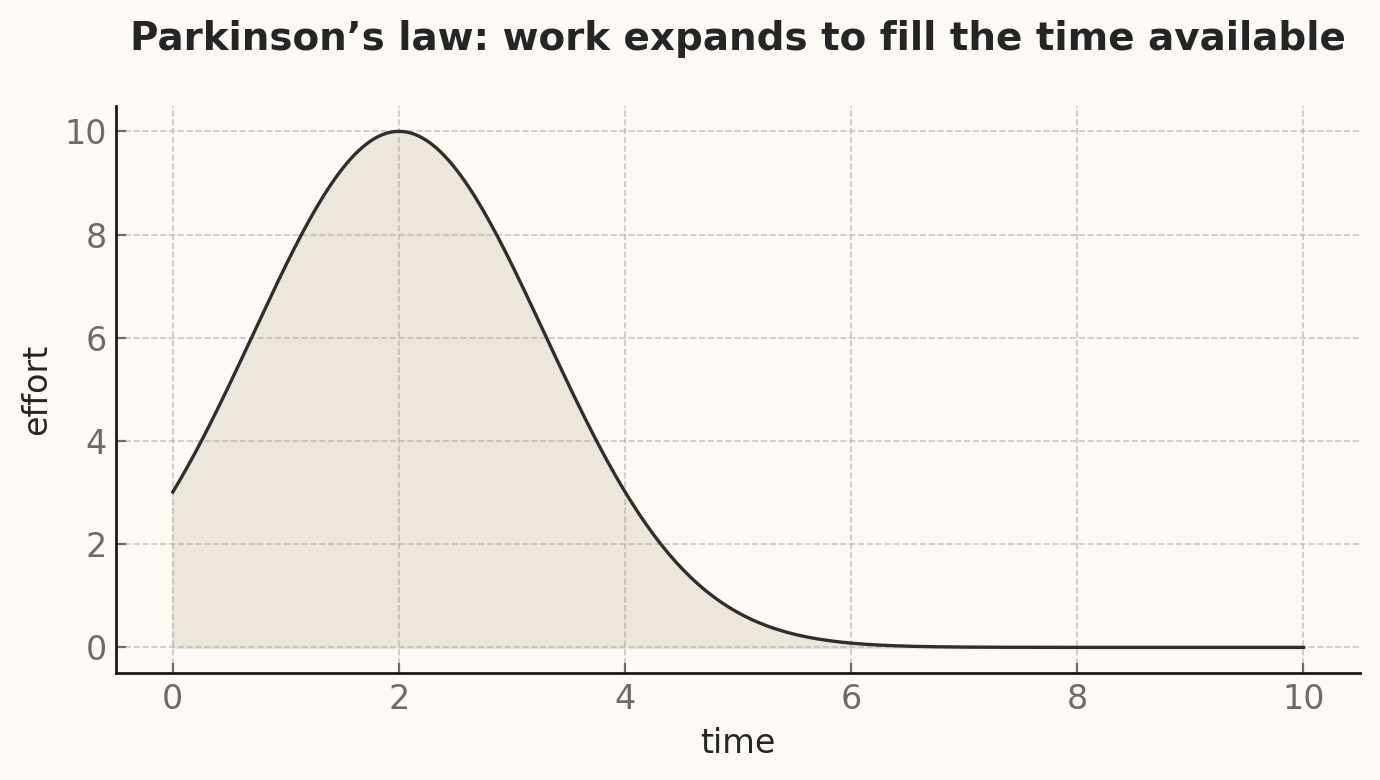
Soon the principle was recognized beyond government. It became shorthand for a universal truth: if you allow two hours for a task, it will probably take two hours, even if it could be completed in one. Left unchecked, Parkinson’s law turns simple work into sprawling commitments.
Why it matters for time and productivity
Parkinson’s law explains why meetings drag past their usefulness, projects stall, and to-do lists never shrink. Without boundaries, tasks naturally swell to consume more time and attention than they deserve.
At work: Preparing a presentation can expand from one hour of focused drafting into a week of fiddling with fonts and slide transitions.
For students: An essay due Friday can dominate the entire week if started early without clear milestones. With no cutoff, editing stretches endlessly.
In personal life: Cleaning the kitchen may swell from a 20-minute tidy-up into an afternoon project of reorganizing cabinets and scrubbing grout.
The risk is not only wasted time. It’s also lost momentum. Tasks that drag out sap energy, encourage procrastination, and disguise avoidance as productivity.
More real-world examples
Developers: Fixing a bug could be solved with a direct patch in an hour, but with no limit set, it becomes a multi-day exploration of peripheral issues.
Writers: Drafting an article can balloon as they endlessly polish phrasing, rather than publishing when the main ideas are solid.
Entrepreneurs: Launching a product gets delayed for months as small features keep expanding the timeline.
Professionals: Weekly team meetings often fill the entire scheduled hour — not because they need that long, but because the calendar allows it.
Everyday routines: Cooking a meal can take 45 minutes if you prep with intention, or twice that if you casually stretch the steps while scrolling your phone.
Once you start noticing Parkinson’s law, it’s hard not to see it everywhere.
Strategies to counter Parkinson’s Law
The good news: awareness gives you leverage. You can design structures to contain this natural tendency.
Set artificial deadlines. Decide when something should be done, even if the official deadline is later. A personal cutoff creates focus and reduces last-minute stress.
Use time boxing. Allocate a fixed block of time for a task and commit to stopping when the block ends. Knowing the boundary creates urgency.
Experiment with sprints. Instead of one open-ended work session, use short bursts — like 25 minutes (Pomodoro technique) — with a clear target for each.
Pair with prioritization. Combine Parkinson’s law with the Pareto Principle: identify the 20% of effort that produces 80% of results, then fit that into a constrained time frame.
Pro tip: finish early on purpose. Challenge yourself to send the draft, complete the workout, or close the laptop a day ahead of schedule. The “done early” habit beats Parkinson’s law at its own game.
The mindset shift
Parkinson’s law is not about working faster at all costs. It’s about giving tasks the time they deserve — no more, no less. By treating time as a constraint rather than an open invitation, you sharpen focus, reduce overthinking, and create space for other priorities.
It also forces you to ask a deeper question: Does this task need to be perfect, or just complete? Most of the time, “good enough” delivered on time outperforms “perfect” delivered too late.
Your call to action
This week, choose one task that routinely consumes more time than it should — writing emails, tidying, studying, or preparing for a meeting. Decide how long it realistically deserves. Set a timer and commit to finishing within that boundary. Then reflect: did the tighter limit reduce waste, or even improve your focus?
Growth often begins not with doing more, but with reclaiming time from what doesn’t need it.