
The Pareto Principle: Doing less for greater impact
The Pareto Principle (80/20 rule) shows that most results come from a small fraction of effort. Learn how to identify your high-impact tasks, avoid busywork, and maximize your time with simple reflection strategies.
Every day brings more tasks than we can reasonably finish. Emails, errands, projects, messages — the list never ends. But what if most of what we do isn’t really moving the needle? The Pareto Principle, better known as the 80/20 rule, suggests that a small fraction of our effort often produces the majority of our results. Learning to spot and lean into that “vital few” can transform the way you manage your time.
What is the Pareto Principle?
The principle originates from Vilfredo Pareto, an Italian economist who, in the late 1800s, observed that 80% of Italy’s land was owned by 20% of its population. Over time, researchers noticed the same pattern in other areas: sales, productivity, even garden pea pods. The ratio isn’t always exactly 80/20, but the general idea holds — a minority of causes often drive the majority of outcomes.
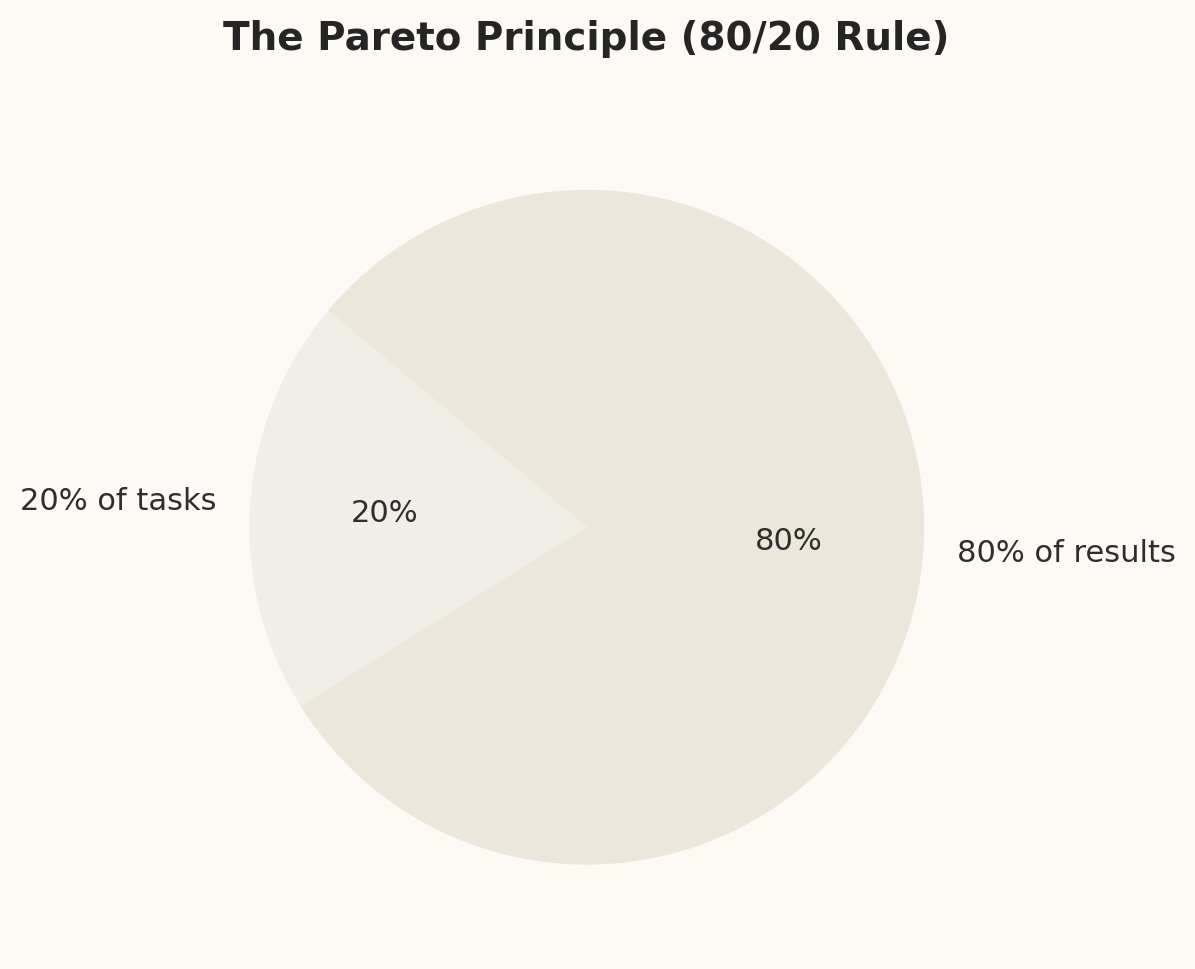
In modern productivity, this translates into a striking truth: a small set of your tasks likely produces most of your meaningful progress, while the rest consume energy without much payoff.
Why the 80/20 rule matters for time management
Most of us treat tasks as equals. We pile them onto lists and cross them off one by one, assuming each deserves similar attention. But in reality:
20% of your clients may drive 80% of your revenue.
20% of features may deliver 80% of user satisfaction.
20% of your habits may generate 80% of your well-being.
The inverse is also true: a large percentage of your tasks may yield only minor results. If you don’t separate the vital few from the trivial many, you risk spreading yourself too thin and diluting your impact.
Reflection prompts: Practicing the 80/20 rule
Find your vital few
Think about your current workload. Which 20% of tasks create the majority of your progress?
Example: a developer may find that writing integration tests and core features delivers 80% of value, while tweaking minor styling consumes time but adds little impact.Spot the trivial many
Which tasks do you spend time on that feel busy but don’t significantly move you forward?
Example: a student might realize they spend hours formatting notes, when reviewing key concepts produces most of their learning.Design your focus
How could you rearrange your day so your highest-energy hours go toward your most impactful tasks?
Example: a professional could reserve their morning focus block for strategic planning or client calls instead of starting with email.Review and adjust
At the end of the week, write down what you achieved. Which actions clearly produced outsized results, and which could you batch, delegate, or drop?
Common traps that hide the vital few
It’s not always obvious which tasks belong to the high-value 20%. A few traps often get in the way:
The busywork illusion: low-impact tasks feel productive in the moment because they’re easy to complete.
Urgency bias: we prioritize what feels urgent, even if it isn’t important.
Habit loops: we repeat tasks out of routine without questioning whether they matter.
Recognizing these traps is the first step toward shifting energy where it matters most.
Practical strategies to apply the Pareto Principle
How do you put the 80/20 rule into practice without overcomplicating your schedule? A few starting points:
Do a weekly review. At the end of the week, list your top results and ask: which tasks created the biggest impact? Patterns will emerge over time.
Keep a “20% list.” As you notice high-leverage tasks, write them down. Use this list to prioritize your daily planning.
Batch the trivial many. Low-value tasks like email or scheduling still need to happen, but batch them into small windows instead of letting them fragment your day.
Use journaling as a filter. Start each morning by writing: If I could only accomplish one task today, which would matter most? That reflection alone can shift focus.
Pro tip: pair the principle with time blocking. Reserve your highest-energy hours (morning for many people) for one or two high-value tasks. Save the rest for later.
Additional real-world applications of the 80/20 principle
Writing: 20% of your outline may shape 80% of your final essay or report. Focus on structure before polishing sentences.
Fitness: 20% of exercises (like squats, push-ups, or running) often deliver most of the health benefits compared to isolated movements.
Studying: 20% of the material (core theories, formulas, or cases) often explains 80% of the test questions.
Project management: 20% of tasks (like key meetings or client deliverables) usually account for most of the project’s success.
Entrepreneurship: 20% of customers or channels often generate 80% of revenue. Identifying them early can save countless hours of unfocused effort.
The mindset shift
The Pareto Principle isn’t just about efficiency; it’s about letting go. Accepting that not everything deserves equal attention creates freedom. By focusing on the few tasks that truly matter, you gain clarity, reduce stress, and often achieve more by doing less.
your call to action
This week, pick one area of your life — work, fitness, relationships, or personal projects. Write down everything you’re doing in that area. Then circle the 20% of actions that drive the most meaningful results. For the next seven days, commit to giving those tasks prime space on your calendar. Notice how it feels to let the rest take a backseat.