
Understanding mood tracking: A data-driven approach to self-awareness
Vitros’ mood tracking system is built on decades of psychological research, combining the Circumplex Model of Affect and PANAS scales into a simple, science-based way to understand your emotions and discover patterns that shape your day.
Mood tracking sounds simple: pick how you feel, log it, move on. But beneath that single tap lies decades of research in psychology, affect science, and emotional regulation.
At Vitros, we built our mood scale from evidence—not vibes—so that each entry helps you understand patterns in your emotional life, not just record them.
The science behind mood
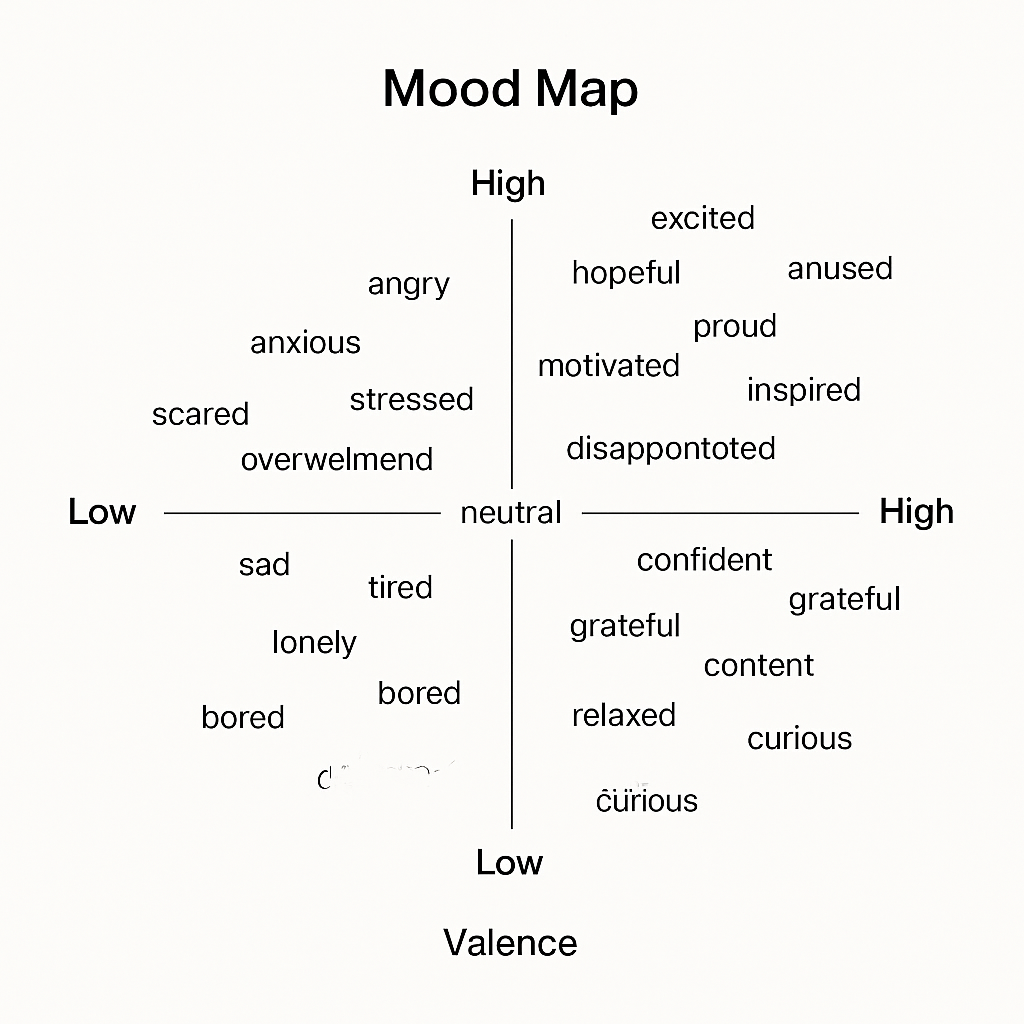
Psychologists describe emotions as dynamic states that can be measured along two primary axes: valence (how pleasant or unpleasant something feels) and arousal (how energized or calm it is).
This model—known as the Circumplex Model of Affect—was first proposed by James Russell in 1980. When mapped in two dimensions, moods form a circle: “excited” sits in the high-energy, pleasant quadrant; “tired” in low-energy, unpleasant; “calm” in low-energy, pleasant; “anxious” in high-energy, unpleasant.
Building on this, researchers like Watson and Tellegen developed the Positive and Negative Affect Schedule (PANAS), a validated scale that identifies patterns of emotional states ranging from “enthusiastic” and “inspired” to “distressed” and “afraid.” These frameworks became the foundation for many mental-health apps, daily diaries, and emotion-research tools.
Our approach
Vitros’ mood tracking blends these validated frameworks with plain language that feels natural to everyday reflection. The result is a 25-term scale that captures both common and clinically recognized emotional states:
none, neutral, happy, sad, angry, anxious, excited, tired, stressed, calm, confident, grateful, lonely, bored, hopeful, scared, proud, overwhelmed, content, motivated, frustrated, relaxed, inspired, disappointed, curious.
This vocabulary covers the full valence–arousal spectrum, allowing users to describe how they feel in the moment without scrolling through an endless list. Each mood has a clear emotional signature—something the human brain recognizes instantly.
Why we built it this way
We didn’t want mood tracking to become another checkbox. Instead, Vitros treats emotion as data with meaning. By observing your mood over time—across journal entries, workouts, or reflections—you begin to see emotional patterns linked to behavior and environment.
The goal isn’t to “fix” negative moods but to understand them. If you consistently feel anxious before social events but calm afterward, that insight is powerful feedback. The simple act of naming an emotion increases emotional granularity—a skill known to improve resilience and decision-making.
How Vitros uses mood data
Each time you record a mood, it syncs across your journals, activities, and reflections. The app then surfaces trends such as:
Average mood by day or week
How moods shift after certain activities
What times of day correspond to peaks and dips
Because mood data is subjective, Vitros keeps it personal: your entries are private, and analytics focus on you vs. you. Over time, AI-generated insights may connect moods to contextual data—sleep, movement, tags, or journaling themes—to help you interpret patterns in a more holistic way.
The bigger picture
Emotion tracking is not about perfection; it’s about awareness. Research consistently shows that people who can identify and label their feelings experience lower stress, greater empathy, and stronger well-being. Vitros’ mood scale simply provides the structure to do that—one tap, one word, one moment at a time.