
How I use ChatGPT as a chapter-by-chapter reading companion
I used ChatGPT as a chapter-by-chapter reading companion to explore vocabulary, themes, and historical context—it changed how I read the classics.
A reading tip I wish I’d discovered years ago: using AI as a chapter-by-chapter companion
I figured this out the other day and immediately felt a little smug—followed quickly by annoyed. Smug because it worked so well. Annoyed because this feels like something I should have been doing for years.
I’ve been reading It Can’t Happen Here by Sinclair Lewis, a book that’s dense, politically charged, and written just far enough outside our moment that you can feel yourself missing things. Not plot points—context. Tone. Subtlety.
Partway through the book, I tried something new. I asked ChatGPT to act as a literary companion—not a summary machine, not a teacher, not a replacement for reading—but something closer to a conversation partner.
Then something unexpected happened.
“Next.”
After finishing a chapter, I typed a single word: “Next.”
And ChatGPT picked up exactly where I was.
It discussed the next chapter—only that chapter. No spoilers. No foreshadowing. No “this will matter later.” Just a grounded, thoughtful discussion of what I had already read: themes emerging, language choices, historical undertones, moments worth lingering on.
I read another chapter.
“Next.”
Again, it followed.
At some point it clicked: this is basically a companion podcast—but interactive.
You know how certain shows now have episode-by-episode breakdowns? You listen after watching, not before. They don’t spoil the arc—they help you process what you just experienced.
That’s exactly what this became. A chapter-level conversation, paced to my reading, responsive to my questions, and—crucially—not rushing me ahead.
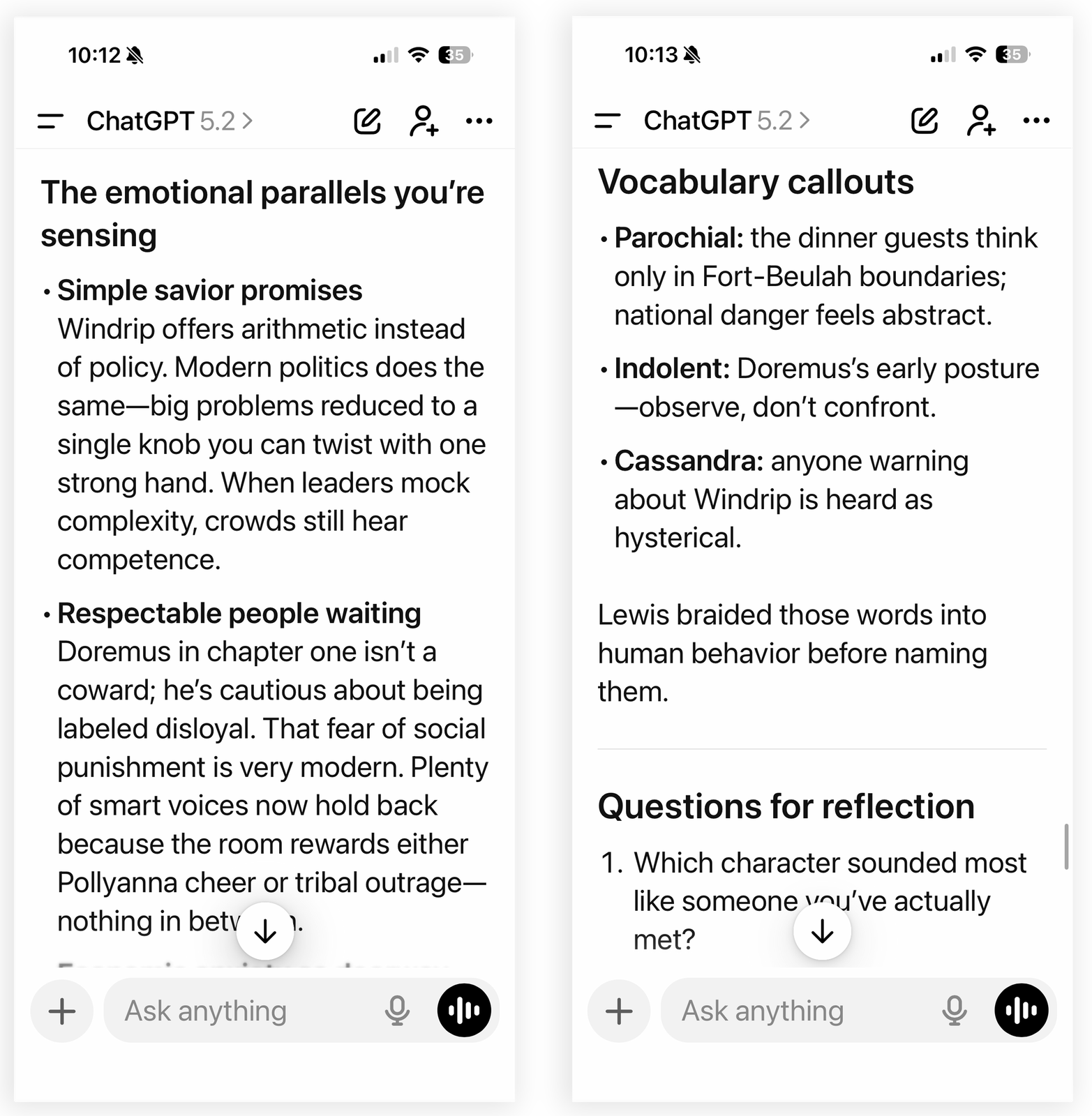
The rule that makes this work: no spoilers, no conclusions
This only works if you’re explicit about boundaries.
From the beginning, I told ChatGPT two important things:
Do not spoil future chapters
Do not tell me what to think or where the book is “going”
That second one matters more than it sounds.
I didn’t want conclusions. I wanted reflection. I wanted help naming things I already felt but hadn’t articulated yet. When a chapter felt ominous or oddly quiet or politically slippery, I didn’t want an answer—I wanted language.
Used this way, AI doesn’t lead you to insights. It helps you slow down enough to arrive at them yourself.
Vocabulary without breaking the spell
Classic novels are full of words we vaguely understand and glide past. Most of the time, that’s fine. But sometimes those words carry social weight that’s been sanded down by time.
Instead of pulling out a dictionary (which usually gives you a sterile, modern definition), I’d ask ChatGPT to explain vocabulary as it would have been understood when the book was written.
Not just “what does this mean?” but:
Was this formal or casual language?
Was it loaded politically or socially?
Would it have sounded neutral—or sharp—to a reader at the time?
That context kept me immersed instead of pulling me out of the story.
Themes you feel before you can name
Some chapters in It Can’t Happen Here made me uneasy without anything obviously happening. No violence. No dramatic speeches. Just… discomfort.
Talking through those chapters helped surface why.
The normalization of authoritarian language. The way ordinary people rationalize small concessions. The comfort of certainty in chaotic times. None of this was spelled out for me—it was reflected back, which is a subtle but important difference.
It didn’t replace my interpretation. It clarified it.
Why this works especially well for classics
I wouldn’t use this for every book.
But for:
Classic literature
Politically or philosophically dense novels
Nonfiction written outside our cultural moment
Anything where context matters as much as plot
This approach turns reading from a solo endurance test into a dialogue.
Historically, reading was social. People argued about books. Wrote letters about them. Discussed chapters as they went. Somewhere along the way, we decided “serious reading” had to be silent and solitary.
This restores that lost middle ground—without spoiling the experience or shortcutting the work.
The prompt I now reuse every time
Here’s the refined version of the prompt I use now. It’s deliberately specific, because boundaries are what make this powerful:
Prompt:
I’m reading [book title] by [author] and I’d like you to act as a literary companion.
After I finish each chapter, I may say “Next.” When I do, discuss only the chapter I’ve just read.
Please help with:
Defining unfamiliar or archaic vocabulary in historical and literary context
Reflecting on themes, tensions, or ideas that emerge in that chapter
Providing relevant historical or cultural context from the time the book was written
Important boundaries:
Do not include spoilers or references to future chapters
Do not lead me toward conclusions or overarching interpretations
Assume I want to think for myself
Keep responses thoughtful, grounded, and aligned with the tone of the book.
That’s it. No complexity. No hacks. Just a better way to read.
This didn’t make reading easier. It made it better.
I didn’t read faster. I read more carefully. I lingered where it mattered. I noticed things I would have skimmed past. And I actually looked forward to the conversation after each chapter.
For books that deserve attention—especially classics—this feels like a genuine upgrade. Not a shortcut. Not a cheat. Just a smarter way to stay engaged.
I’m not giving this one up.